Clinical workflow platform · Concept
A clinician-led workflow for safer result review, clearer decisions, and reliable follow-up
Turning a fragmented, high-risk review process into one structured, accountable workflow.
- Role
- Product Designer / UX/UI Designer
- Platforms
- Web
- Industry
- Healthcare
Overview
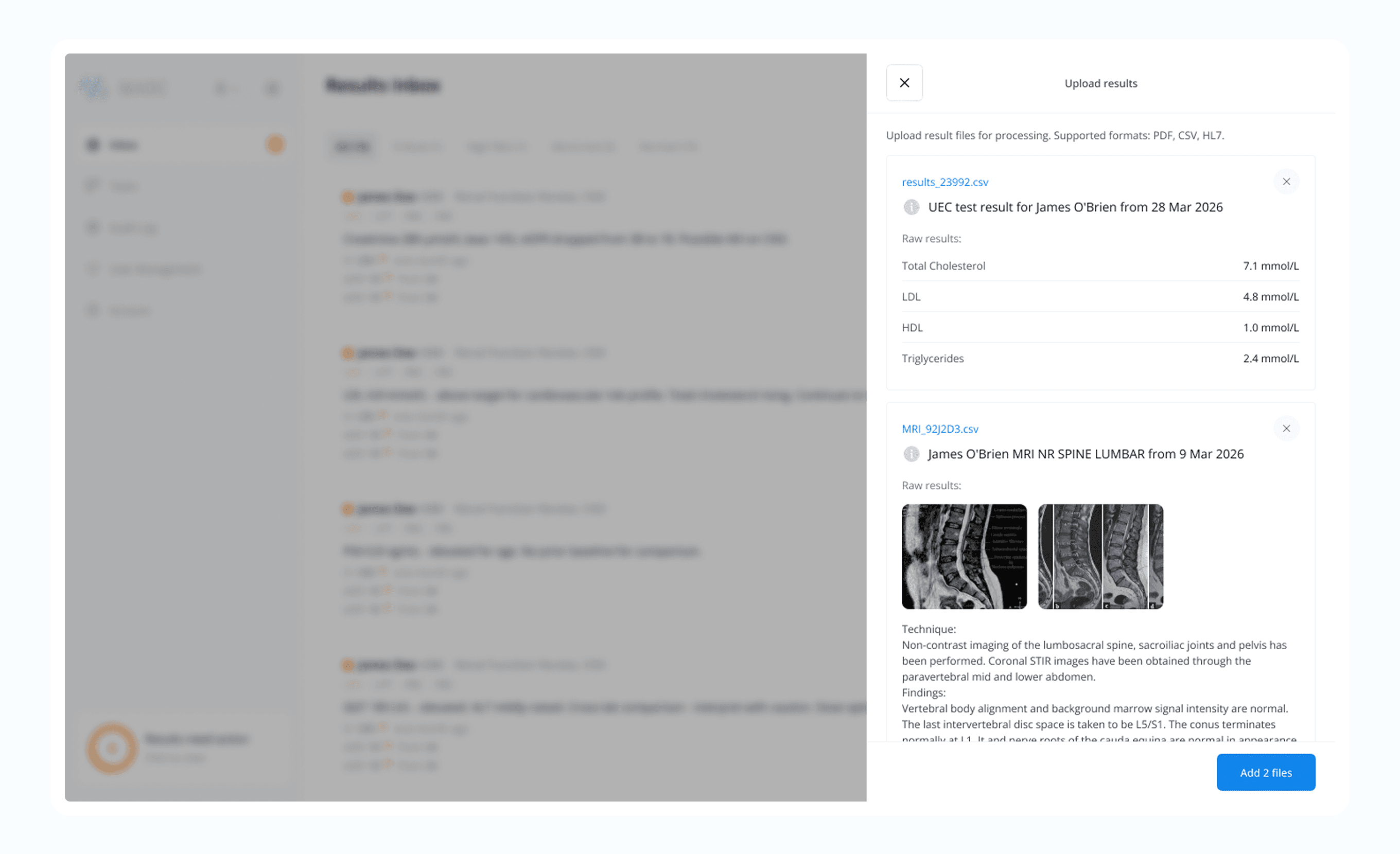
Clinical teams review a continuous stream of blood tests, imaging reports, discharge summaries and specialist letters - arriving at different times, from different sources, without the context needed to understand their significance quickly.
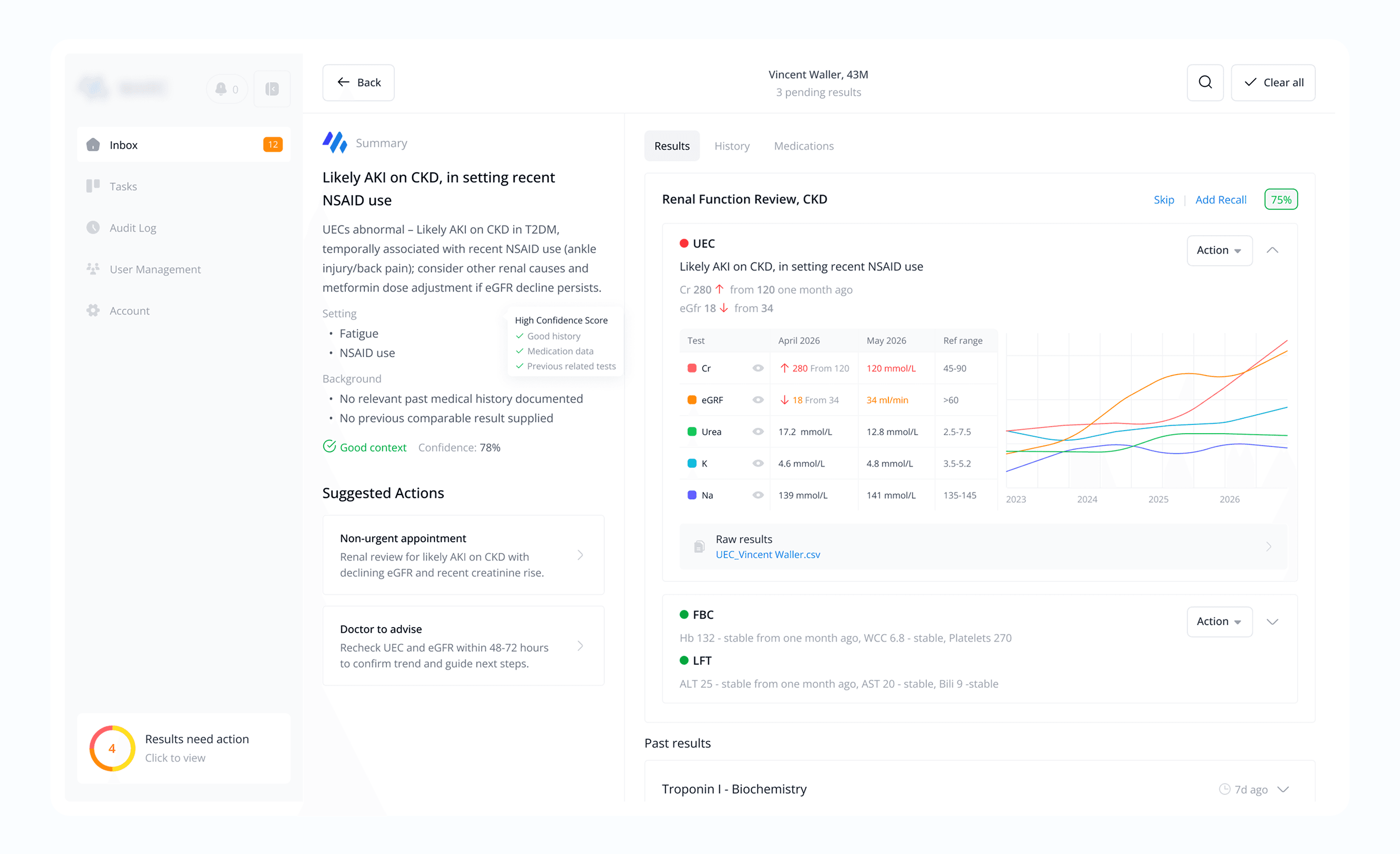
I designed a clinician-facing workflow assistant that turns this fragmented process into a structured path from incoming result to interpretation, action and tracked follow-up. The product doesn't replace clinical judgement - it reduces noise, surfaces relevant context, and presents practical next steps a clinician can approve, edit, delegate, defer or ignore.
The problem
A high-frequency task with a disproportionate cognitive cost
Most results are routine, but each still requires attention and sign-off. Important abnormalities can be buried among low-risk items, and interpretation is complicated by different laboratories, reference ranges, units, incomplete history and missing clinical notes.
Clinicians repeatedly have to answer the same questions: is this normal, abnormal or critical; is the patient improving or deteriorating; why does it matter for this patient now; what's the safest next step; and who is responsible for completing it. The existing workflow put the burden of rebuilding that context, and coordinating the follow-up, almost entirely on the clinician.
My role
Product Designer / UX/UI Designer
I translated an early clinician-authored product brief and evolving stakeholder requests into a coherent product structure and interface - the MVP scope, the end-to-end workflow for every user role, the information architecture, and the confidence and urgency systems that make the interpretation trustworthy rather than opaque.
A major part of the work was turning incomplete clinical logic into a practical UX model, while clearly separating confirmed requirements from assumptions.
Key UX decisions
Eight decisions behind a safety-first workflow
01
Prioritisation, not storage
Each result group surfaces urgency, context quality and why it matters, with filters for critical, high-risk, abnormal and normal results.
02
Urgency vs. context quality
Two independent signals instead of one confidence score - a critical result with limited supporting context still prompts closer review.
03
One review context per case
Related tests are grouped under a meaningful title, so clinicians see the overall interpretation before expanding into raw values.
04
Clinician stays in control
Every suggested action is editable, high-risk actions require deliberate confirmation, and nothing is sent automatically.
05
Every action has an owner
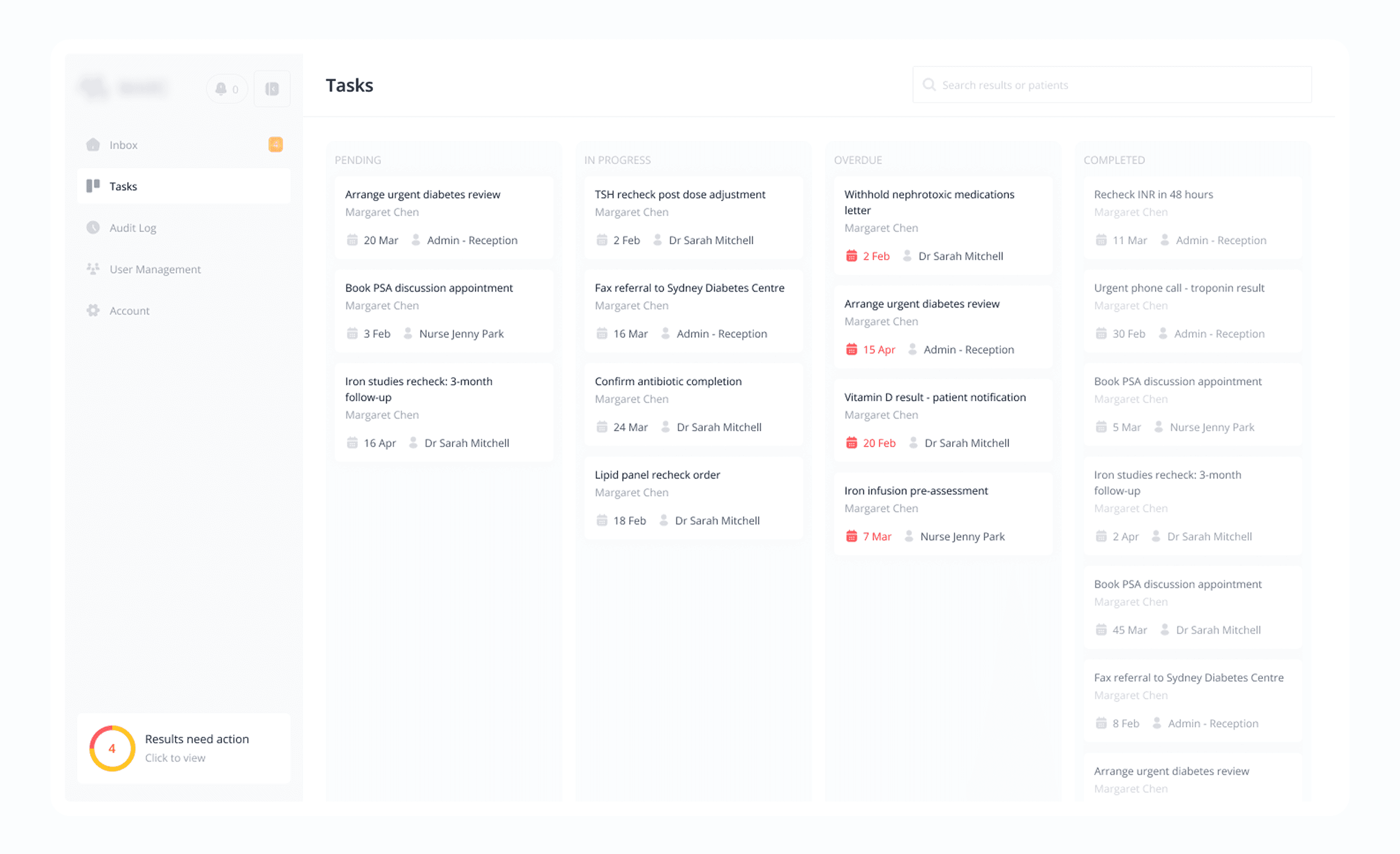
A reusable action drawer connects each decision to operational follow-up - assignee, priority, due date and instructions.
06
Conditional, context-aware referrals
Referrals appear only when a clear next pathway exists, with an explicit warning when supporting information is incomplete.
07
History as a narrative
A readable patient-level timeline, not a technical event table - a separate audit log preserves formal traceability.
08
Medications kept scannable
Name, dose, frequency, notes and status - surfacing only what's clinically relevant to the current review.
Safety and trust
Non-negotiable principles
The product was designed around a fixed set of principles: clinicians remain the decision-makers; AI output must be explainable and traceable to source information; uncertainty and missing context must stay visible; unsafe comparisons are flagged rather than silently interpreted; high-risk actions require human confirmation; follow-up ownership and timing remain visible; and every action, suggestion and outcome is auditable.
These principles shaped both the interaction design and the information hierarchy throughout the product, rather than being a compliance afterthought.
Follow-up
Result intake
Designed outcome
From fragmented review to one accountable workflow
Instead of moving between reports, patient records, notes, medication lists, task systems and referral tools, the clinician can review the essential context, make a decision, and route the follow-up from one place.
This is a design concept validated through an MVP prototype, not a shipped, measured product - the outcomes above describe the intended effect of the model, not field-measured results.
Reflection
This project explored how AI can support clinical work without taking control away from clinicians. The central design challenge was never adding more information - it was deciding what to surface, when to surface it, and how to connect interpretation with accountable follow-up.
Combining prioritisation, patient context, transparent suggestions, task routing, referral drafting and auditability turns results review from a fragmented administrative burden into a clearer, more manageable clinical workflow.
Contact
Open to Senior Product Designer roles.
If you're hiring for a senior product design role, or want to talk through how I work, I'd like to hear from you.
hello@romanshimin.com- LinkedIn profile
- Location
- Montenegro (Remote)
- Availability
- Open to Senior Product Designer roles, remote or relocation.